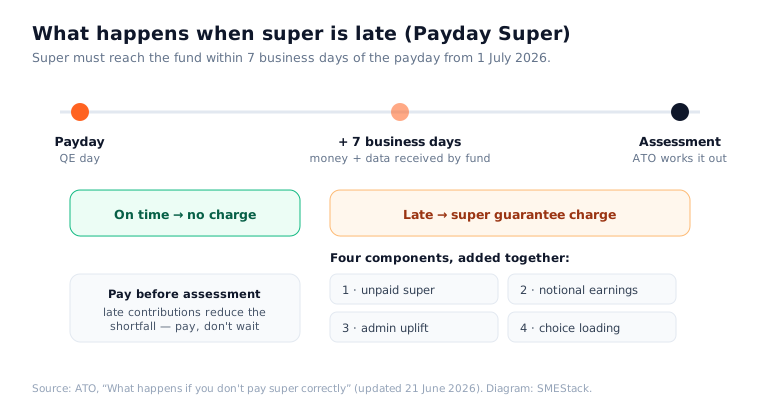
Since 1 July 2026 super must reach your employee's fund within 7 business days of each payday, with enough information to allocate the contribution to the right member account. If it does not, the ATO works out a super guarantee charge and sends you a notice of assessment. You no longer lodge a super guarantee statement — that part of the old process ended with quarterly super.
This page explains what the charge is made of, what the ATO actually does in its first year of Payday Super, and the fastest way to limit the cost when a payment goes in late.
What the charge is made of
For each payday where super was short, four components are added together:
- Unpaid super (the shortfall) — 12% of qualifying earnings for that payday, less any on-time or late contributions received before the assessment.
- Notional earnings — interest calculated at the general interest charge rate and compounded daily for each day the shortfall exists.
- An administrative uplift — a charge for enforcement cost. It starts at 60% of the shortfall plus notional earnings, and is reduced — potentially to nil — where you have no ATO-initiated assessment in the two years before that payday and you fix the problem quickly.
- Choice loading — an additional amount if you did not follow the choice of fund rules.
The administrative uplift is the part that changes most with your behaviour. On the ATO's reduction scale, an employer with no recent ATO-initiated assessment pays nothing extra if the charge is paid within 30 days of the payday, and the percentage climbs the longer the shortfall stands — so a fortnight of delay costs materially less than leaving it for a quarter.
It is deductible now — that changed
The old super guarantee charge was not tax deductible, which made a late payment expensive twice over. For charges relating to Payday Super paydays the ATO confirms you can claim a tax deduction for the super guarantee charge. The charge is still money you would rather not spend, but the tax treatment is no longer punitive.
What to do when a payment is late
- Pay the fund as soon as you notice. Contributions received after the 7 business days but before the ATO assesses you reduce the shortfall. Waiting for the assessment only lets notional earnings and the administrative uplift grow.
- Read the assessment carefully. Check the qualifying earnings, the super guarantee shortfall, and the choice loading against your payroll records before you pay it.
- Pay within 28 days of the assessment. After that the ATO issues a Notice to Pay, and a late payment penalty applies on top.
The ATO's first-year approach is deliberately gentle
Under PCG 2026/1 the ATO has said it will not review employers who are paying super for each payday and fixing errors quickly. In its first year of Payday Super, compliance action is aimed at employers who are not moving to more frequent payments, not correcting errors, or not paying super at all. That is a runway, not an exemption — the obligation and the charge are unchanged.
Keeping out of it
Late super is almost always a process problem rather than a cash problem. Three things prevent it: payroll software that calculates super on qualifying earnings at each pay run, a payment path that can settle within 7 business days every time, and a calendar reminder on the payday rather than on the old quarterly dates. If you are still working out what the switch does to your cash flow, the Payday Super cash-flow calculator models your own pay cycle. If a file has been rejected rather than paid late, the SuperStream error decoder explains the code before you re-lodge.
Reviewed 18 November 2026 against ATO guidance on Payday Super and the super guarantee charge. This is general information, not tax advice.