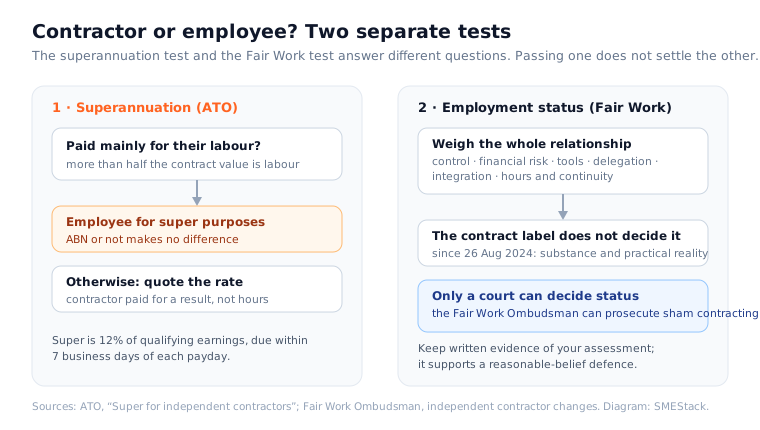
Two different questions get collapsed into one, and it costs businesses money in both directions. "Is my contractor an employee?" is not a single test: superannuation has its own rule under the tax law, and employment status has its own rule under the Fair Work Act. A worker can be a contractor for one and an employee for the other.
One correction to a lot of what is written about this: there is no "deemed employee" status created in 2026, and the Fair Work Commission does not classify workers. What actually applies is set out below.
Test 1 — superannuation (ATO): are you paying for labour?
If you pay an independent contractor mainly for their labour, they are an employee for superannuation guarantee purposes. The ATO's test is practical: more than half the dollar value of the contract is for their labour, you pay for their personal labour and skills, and payment is not dependent on achieving a specified result.
- An ABN makes no difference. Quoting an ABN does not remove the obligation.
- Super is 12% of qualifying earnings, due within 7 business days of each payday under Payday Super.
- If the contractor is paid for a result rather than for hours, and carries their own risk on the outcome, the labour test is less likely to be met.
Test 2 — employment status (Fair Work): the whole relationship
Since 26 August 2024 the Fair Work Act requires some businesses to look at the real substance, practical reality and true nature of the relationship rather than the label on the contract. That test does not apply to state-referred businesses, and it does not change the meaning of "employee" for tax or superannuation.
No single factor decides the answer. The factors weighed together are control over how the work is done, financial risk and responsibility for the result, who supplies tools and equipment, whether the worker can delegate or subcontract, how integrated they are into your business, hours, and whether both sides expect the work to continue.
Where a dispute runs, only a court decides status. The Fair Work Ombudsman cannot determine whether a person is a contractor or an employee — it can give information, and it can prosecute sham contracting.
Sham contracting is the real risk, not "deemed employees"
Sham contracting is representing to a worker that they are a contractor when they are in fact an employee. It is unlawful unless you can show you reasonably believed the engagement was genuine contracting — the defence changed on 27 February 2024 from an honesty-based test to a reasonable-belief test, which is why written evidence of your assessment now matters.
The exposure is civil penalties for the sham arrangement itself, plus back-payment of wages, superannuation and leave entitlements if a court finds the person was an employee. There is no separate "deemed employee" penalty, and no automatic mechanism that reclassifies a workforce.
What actually changed for contractors in 2026
The 2026 change is in superannuation, not in classification: since 1 July 2026 super for contractors paid mainly for labour is calculated on qualifying earnings, which folds in payments such as overtime that were previously outside ordinary time earnings. Quarterly payment is gone. If you engage the same contractor regularly, that is now a per-payday obligation, not a quarterly one.
What to do about it
- Run both tests, separately, for each regular contractor — the super test first, because it is the one that generates a charge automatically.
- Write down the answers and the evidence. A reasonable-belief defence depends on what you assessed at the time, not what you reconstruct later.
- Check the arrangement itself. If the contractor works your hours, uses your equipment and cannot delegate, the label is doing work the facts do not support.
- Where the answer is genuinely unclear, get advice before the next payment run rather than after an audit.
The contractor due diligence tool walks through the factors and records your answers. It produces an assessment, not a legal ruling — for a binding view, take the result to an accountant or employment lawyer.
Reviewed 18 November 2026 against ATO guidance on super for independent contractors and Fair Work Ombudsman guidance on independent contractor changes. General information, not legal advice.